
Hydraulic Mechanical Specific Energy (HMSE) in Drilling
Share Your Thoughts and Additional Information
Key Questions Answered in This Article
What is Hydraulic Mechanical Specific Energy (HMSE)?
Why can MSE sometimes provide an incomplete picture of drilling efficiency?
How do hydraulics influence drilling performance?
How can HMSE be used to improve Rate of Penetration (ROP)?
What drilling problems can HMSE help identify?
How do bit nozzles, flow rate, and pressure losses affect HMSE?
When is HMSE most valuable?
How can drilling teams apply HMSE in real-time optimization?
Why HMSE Matters
Mechanical parameters like Weight on Bit (WOB), torque, and rotary speed are basic to breaking rock and optimizing drilling. However, experience in the field shows that just increasing mechanical energy does not always lead to better drilling performance.
A lot of drilling problems come up when cuttings are not properly cleared from the bit. Poor bit cleaning, cuttings building up, regrinding already drilled rock, bit balling, and not cleaning the hole well enough can all slow down drilling, even if the mechanical parameters look good.
Hydraulic Mechanical Specific Energy (HMSE) was introduced to give a fuller picture of drilling performance by looking at both mechanical and hydraulic energy in the drilling process. By including hydraulics, HMSE helps drilling teams see where energy is lost and where there is room to improve.
2. From Mechanical Specific Energy to HMSE
The idea of measuring drilling efficiency started with Teale's (1965) Specific Energy concept, which looked at how much energy it takes to remove a certain amount of rock. The main point is simple: if it takes too much energy to drill, there is probably some inefficiency in the system.
This idea later became Mechanical Specific Energy (MSE), which adds up the energy from WOB and torque into one number for drilling efficiency. MSE is now a key tool in the industry because it helps teams spot energy losses, drilling problems, and ways to improve Rate of Penetration (ROP).
MSE is still widely used, but it mainly looks at mechanical energy. As wells have become longer, deeper, and more complicated, it has become clear that hydraulics also play a big part in drilling efficiency. This is why HMSE was developed.
3. What Is Hydraulic Mechanical Specific Energy?
Hydraulic Mechanical Specific Energy builds on MSE by also including the hydraulic energy from drilling fluid circulation.
Conceptually:
HMSE = Mechanical Energy + Hydraulic Energy Contribution
Unlike standard MSE, there is no single HMSE equation used by everyone. Different companies and researchers include hydraulic energy in different ways, such as:
Bit Hydraulic horsepower
Nozzle pressure losses
Jet impact force
Hydromechanical energy models
Pressure-based energy formulations
Even though the math can be different, the goal is the same: to give a better picture of drilling efficiency by including hydraulic effects that MSE alone does not show.
HMSE is meant to add to MSE, not replace it. MSE is still the main drilling efficiency metric in the industry, but HMSE gives extra information when hydraulics have a big impact on drilling.
4. How Hydraulics Improve Rock Removal
Hydraulics affect drilling in several key ways.
Bit Cleaning
Drilling fluid jets keep the bit clean by washing away cuttings from around the cutters. Clean cutters stay in good contact with fresh rock, which helps drilling go faster and smoother.
Chip Evacuation
When the bit breaks rock, the chips need to be cleared out fast. If chips are not removed, they pile up under the bit, slow down drilling, and use more energy.
Prevention of Regrinding
If cuttings stay under the bit, energy is wasted regrinding old material instead of making new hole. Good hydraulics help avoid this problem.
Hole Cleaning
Hydraulic energy moves cuttings up the annulus and stops cuttings beds from forming. This is especially important in high-angle, horizontal, and extended-reach wells.
Reduction of Bit Balling
Sticky formations can stick to the bit and cutters. Good hydraulic cleaning helps stop bit balling and keeps the bit working well.
Support of Cutter-Rock Interaction
Recent work on HMSE shows that hydraulics do more than just move cuttings. Fluid flow also affects how chips are removed, pressure at the bit, how well cutters are exposed, and how efficiently the bit breaks rock.
5. Interpreting HMSE Trends
Like MSE, HMSE is most useful when you look at the trend over time, not just a single value.
Rising MSE and Rising HMSE
This often indicates increasing drilling inefficiency caused by:
Poor hole cleaning
Bit wear
Bit balling
Cuttings accumulation
Increasing friction
Drilling dysfunctions
Stable MSE but Rising HMSE
Mechanical efficiency may appear unchanged while hydraulic performance is deteriorating. Possible causes include:
Reduced annular cleaning
Nozzle plugging
Poor cutting transport
Increasing hydraulic losses
Improving HMSE with Increasing ROP
This usually means that hydraulic settings have been improved and drilling is more efficient.
6. Practical Applications of HMSE
Horizontal Wells
Horizontal sections often have trouble moving cuttings. HMSE can help spot hole-cleaning problems early, before cuttings beds become a big issue.
Extended-Reach Wells (ERD)
ERD wells often run close to hydraulic and mechanical limits. HMSE gives extra information to see if drilling is being held back by hydraulics instead of mechanical factors.
Deepwater Wells
Deepwater operations frequently involve narrow pressure windows and complex hydraulic environments. HMSE can support optimization while maintaining safe operating margins.
Real-Time Drilling Optimization
Drilling teams now watch HMSE along with MSE, ROP, torque, standpipe pressure, and vibration data to find ways to optimize drilling in real time.
Drilling Automation and Digital Drilling
Recent work has added HMSE into advanced drilling control systems, digital models, and machine learning setups. Instead of just chasing ROP targets, these systems aim to improve drilling efficiency while keeping drilling stable and safe.
7. Limitations of HMSE
Although HMSE provides a more comprehensive representation of drilling efficiency than traditional MSE, several limitations remain.
No Universal Industry Standard
Different ways of calculating HMSE can give different results because hydraulic energy can be worked out in several ways.
Hydraulic Efficiency Is Difficult to Quantify
Not all hydraulic power reaches the rock. Energy losses occur through:
Friction
Turbulence
Flow redistribution
Nozzle inefficiencies
Surface Measurements May Not Represent Downhole Conditions
A lot of HMSE calculations use surface data, which can be quite different from what is really happening at the bit.
HMSE Is Not a Standalone Optimization Metric
HMSE should be evaluated together with:
MSE
Vibration measurements
Bit condition
Formation properties
Directional requirements
Wellbore quality objectives
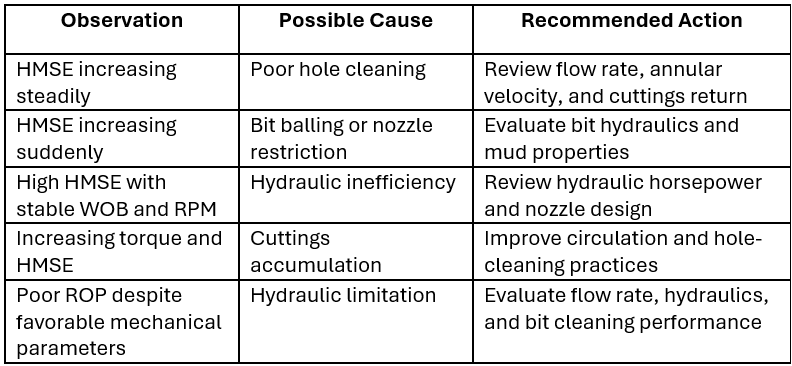
8. Field Troubleshooting Guide
9. Common Misconceptions About HMSE
HMSE Replaces MSE
False. HMSE complements MSE by adding hydraulic insight.
Higher Flow Rate Always Improves HMSE
False. Excessive flow may increase pressure losses, ECD, or hydraulic inefficiencies.
HMSE Directly Predicts Formation Strength
False. HMSE is primarily an efficiency indicator, not a direct measure of rock strength.
HMSE Alone Can Optimize Drilling
False. Effective optimization requires integration with other drilling and geological measurements.
Key Takeaways
HMSE builds on MSE by including the effects of hydraulic energy.
Hydraulics affect drilling efficiency by helping with bit cleaning, chip removal, hole cleaning, and moving cuttings.
There is currently no universally accepted HMSE equation till 2025.
HMSE is particularly valuable in horizontal, ERD, and deepwater wells.
Watching HMSE in real time can help tell if drilling problems are due to hydraulics or mechanical issues.
HMSE should be viewed as an enhancement of MSE rather than a replacement.
HMSE is most useful for helping make operational decisions and spotting inefficiencies that mechanical metrics might miss.
References
Bourgoyne, A.T., Millheim, K.K., Chenevert, M.E., and Young, F.S. 1991. Applied Drilling Engineering. SPE Textbook Series Vol. 2. Richardson, Texas: Society of Petroleum Engineers.
Dupriest, F.E. and Koederitz, W.L. 2005. “Maximizing Drill Rates with Real-Time Surveillance of Mechanical Specific Energy.” Proceedings of the SPE/IADC Drilling Conference, Amsterdam, The Netherlands, 23–25 February. SPE-92194-MS.
Mitchell, R.F. and Miska, S.Z. 2011. Fundamentals of Drilling Engineering. SPE Textbook Series Vol. 12. Richardson, Texas: Society of Petroleum Engineers.
Mohan, K., Adil, F., and Samuel, R. 2014. “Comprehensive Hydromechanical Specific Energy Calculation for Drilling Efficiency.” Journal of Energy Resources Technology 136 (1): 013101.
Pessier, R.C. and Fear, M.J. 1992. “Quantifying Common Drilling Problems with Mechanical Specific Energy and a Bit-Specific Coefficient of Sliding Friction.” Proceedings of the SPE Annual Technical Conference and Exhibition, Washington, D.C., 4–7 October. SPE-24584-MS.
Teale, R. 1965. “The Concept of Specific Energy in Rock Drilling.” International Journal of Rock Mechanics and Mining Sciences 2 (1): 57–73.
Xu, B., Meng, Z., Liu, W., Luo, X.L., et al. 2023. “Improving Drilling Efficiency and Safety Based on Hydraulic Mechanical Specific Energy in the Framework of Economic Model Predictive Control.” SPE Journal 28 (4). SPE-214292-PA.