
Mechanical Specific Energy (MSE) in Drilling -
Using MSE to Identify Energy Losses, Improve ROP, and Optimize Drilling Performance
Share Your Thoughts and Additional Information
Key Questions Answered in This Article
What is Mechanical Specific Energy (MSE)?
Why is MSE one of the industry's most important drilling optimization metrics?
How does MSE relate to rock strength?
What drilling dysfunctions can MSE identify?
What are the limitations of traditional MSE?
What do recent industry discussions say about MSE?
How are operators using MSE today?
What are the emerging developments in MSE-based optimization?
1. Why Mechanical Specific Energy Matters
A common challenge in drilling is figuring out if the energy put into the drill bit is actually breaking the rock or just getting lost somewhere else in the system. Sometimes, even with plenty of weight on the bit, torque, hydraulic power, and rotary speed, the rate of penetration stays low. Often, the problem is not a lack of energy, but that the energy is not being transferred efficiently to the bit.
Mechanical Specific Energy (MSE) was introduced to measure this issue. Instead of looking at drilling parameters one by one, MSE shows how much mechanical energy is being used to remove a certain volume of rock. This helps drilling teams understand efficiency and spot where energy is being lost and is hurting the performance.2. The Origin of the MSE Concept
The concept was introduced by Teale in 1965. Teale recognized that every rock type requires energy to fail and that drilling performance could be evaluated by comparing the energy supplied to the energy actually required to remove rock. Subsequent work by industry practitioners transformed MSE from an academic concept into one of the most widely used drilling surveillance tools in modern operations.
Real-time data acquisition systems now allow continuous MSE calculations using surface and downhole measurements, enabling drilling teams to monitor efficiency throughout the drilling process.3. Understanding the Physics Behind MSE
Mechanical energy gets to the bit in two main ways: through the weight on bit (WOB) pushing down, and through torque and rotary speed turning the bit. MSE brings these factors together into one number that can be tracked during drilling.
If MSE goes down and ROP goes up, it usually means drilling is getting more efficient. If MSE rises but ROP stays the same or drops, it often points to problems or inefficiencies in the drilling system. MSE combines both energy components into a single efficiency indicator in the following equation.
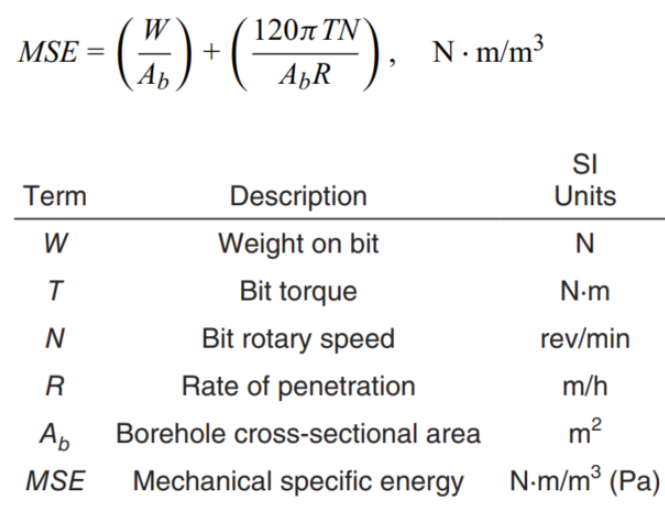
4. How MSE Differs from Traditional Optimization
Traditional drilling optimization is mostly about changing parameters step by step and watching how ROP responds. It often follows a trial-and-error approach:
Increase WOB
Observe ROP
Increase RPM
Observe ROP
MSE gives a more systematic way to see how well the drilling energy is actually being used. The objective becomes:
Maximize ROP while minimizing MSE.
Modern rigs continuously acquire:
WOB
Torque
RPM
ROP
These measurements allow MSE to be calculated continuously in real time.
Real-time monitoring enables drilling teams to detect inefficiencies before they significantly impact performance. Instead of just pushing for higher WOB or RPM, the goal is to get the best possible ROP with the lowest MSE, while still keeping the well stable, the hole in good shape, and the equipment running reliably.
5. MSE and Rock Strength: Current Industry Perspective
Historically, many drilling optimization workflows compared MSE against Unconfined Compressive Strength (UCS) and sought operating conditions where MSE approached UCS. However, SPE publications from 2023 through 2025 and discussions at different industry forums have highlighted important limitations in treating MSE as a direct proxy for formation strength. MSE and UCS represent different physical quantities and are influenced by different mechanisms. While significant divergence between MSE and estimated rock strength may indicate inefficiencies, MSE is generally more reliable as a relative drilling efficiency indicator and trend-monitoring tool than as a direct measure of formation strength. The emerging industry consensus is not that MSE is invalid, but rather that comparisons between MSE and UCS should be interpreted carefully and within the broader operational context.
6. MSE Measures Mechanical Efficiency, Not Total Drilling Performance
One of the most important lessons from recent industry discussions is that MSE measures mechanical efficiency rather than total drilling performance.
MSE is most useful when viewed as an efficiency indicator rather than an absolute number.
A high MSE means more energy is required to drill the rock.
This may indicate:
Inefficient drilling
Energy losses
Equipment limitations
Drilling dysfunctions
A lower MSE indicates:
Better energy transfer
Improved rock cutting
More efficient drilling
The objective is generally to achieve the lowest practical MSE while maintaining operational stability. A lower MSE usually means energy is getting to the bit more effectively. But overall drilling performance also depends on meeting directional targets, keeping the wellbore in good condition, managing vibrations, cleaning the hole, making sure equipment is reliable, working safely, and controlling costs. So, MSE is a useful tool to support decisions, but it should not be used as the only measure of drilling success.
7. Detecting Drilling Dysfunctions with MSE
MSE is especially helpful for spotting drilling problems. Stick-slip may be indicated by fluctuating torque, irregular RPM, and rising MSE. Bit whirl often appears as increasing MSE combined with accelerated cutter wear and poor directional response. Bit bounce may present as oscillating WOB, reduced ROP, and elevated MSE. In extended-reach and high-angle wells, poor weight transfer can cause MSE to go up even if more WOB is applied at the surface. Looking at MSE together with vibration readings and other drilling data can help find out what is causing performance to drop.
Poor hole cleaning is still one of the main reasons for high MSE. When cuttings build up, they increase torque, drag, and friction, and make it harder to get the weight down to the bit. Often, improving circulation, raising annular velocity, or getting the hydraulics right does more to lower MSE than just adding more WOB. That’s why MSE should always be checked together with hydraulic performance.
If MSE goes up and ROP drops, it often points to bit wear, bit balling, vibration issues, poor hydraulics, or changes in formation. If both torque and MSE are rising, it could mean cuttings are building up, or there are hole cleaning problems. The best way to troubleshoot is to look at MSE trends along with torque, vibration data, hydraulics, well path, and formation details, instead of just looking at MSE by itself.
8. Recent Industry Debate: Facts, Fallacies, and Pitfalls
A series of SPE publications between 2023 and 2025 stimulated extensive industry discussion regarding common assumptions surrounding MSE. These papers challenged several widely repeated claims, including the idea that MSE should always converge toward UCS and the assumption that MSE alone can fully characterize drilling efficiency. The debate ultimately reinforced the value of MSE while encouraging more rigorous interpretation and greater awareness of its limitations. Importantly, the industry has not abandoned MSE. Instead, many organizations have adopted a more balanced approach in which MSE is used alongside other performance indicators.
9. Emerging MSE Developments and Advanced Applications
The evolution of MSE has led to several enhanced formulations and applications. These developments include Hydraulic Mechanical Specific Energy (HMSE), Downhole MSE, Total MSE, pressure-corrected MSE, automated drilling optimization, and machine learning. Today, digital drilling setups often use MSE together with vibration data, bit condition checks, formation evaluation, and hydraulic models to get a clearer picture of drilling performance. Many operators now use MSE as one input within broader drilling optimization frameworks rather than as a standalone metric.
10. Limitations of Traditional MSE
Traditional MSE calculations do not include hydraulic energy directly and usually depend on surface measurements, which can be quite different from what is happening downhole. MSE is also affected by changes in ROP, since ROP is part of the calculation. Differences in formation, drillstring movement, friction losses, and measurement errors can also change the results. Because of this, most experienced drilling teams watch MSE trends instead of just looking at the numbers, and always use MSE along with other measurements.
11. Best Practices for Using MSE
Monitor trends rather than isolated values.
Evaluate MSE together with vibration data.
Consider hydraulics and hole-cleaning performance.
Interpret MSE within the geological context.
Use real-time monitoring whenever possible.
Avoid relying on MSE as the sole optimization metric.
Integrate MSE into broader drilling performance workflows.
Key Takeaways
MSE remains one of the industry's most powerful drilling surveillance metrics.
It helps identify energy losses and drilling inefficiencies.
MSE is most valuable as a trend-monitoring and decision-support tool.
Comparisons with rock strength can provide useful context but should be interpreted cautiously.
Modern optimization increasingly combines MSE with HMSE, vibration monitoring, hydraulics, automation, and digital workflows.
The greatest value of MSE lies not in the calculation itself but in the operational decisions it enables.
References
Bourgoyne, A.T., Millheim, K.K., Chenevert, M.E., and Young, F.S. 1991. Applied Drilling Engineering. SPE Textbook Series, Vol. 2. Richardson, Texas: Society of Petroleum Engineers.
Dupriest, F.E. and Koederitz, W.L. 2005. “Maximizing Drill Rates with Real-Time Surveillance of Mechanical Specific Energy.” Paper SPE/IADC 92194 presented at the SPE/IADC Drilling Conference, Amsterdam, The Netherlands, 23–25 February. https://doi.org/10.2118/92194-MS.
Macpherson, J.D. 2025. “Mechanical Specific Energy: Derivation, Understanding and Relationship to Formation Strength.” Paper SPE/IADC 223707 presented at the SPE/IADC International Drilling Conference and Exhibition, Stavanger, Norway. https://doi.org/10.2118/223707-MS.
Mitchell, R.F. and Miska, S.Z. 2011. Fundamentals of Drilling Engineering. SPE Textbook Series. Richardson, Texas: Society of Petroleum Engineers.
Mensa-Wilmot, G. and Samuel, R. 2024. “Mechanical Specific Energy (MSE): Claims and Implications—Facts, Fallacies, and Pitfalls (Part 2).” Paper SPE/IADC 217727 presented at the IADC/SPE International Drilling Conference and Exhibition, Galveston, Texas, USA, 5–7 March. https://doi.org/10.2118/217727-MS.
Pessier, R.C. and Fear, M.J. 1992. “Quantifying Common Drilling Problems with Mechanical Specific Energy and a Bit-Specific Coefficient of Sliding Friction.” Paper SPE 24584 presented at the SPE Annual Technical Conference and Exhibition, Washington, D.C., USA, 4–7 October.
Samuel, R. and Mensa-Wilmot, G. 2023. “Facts, Fallacies and Pitfalls of Using Mechanical Specific Energy (MSE)—Part 1.” Paper SPE/IADC 212508 presented at the IADC/SPE International Drilling Conference and Exhibition, Stavanger, Norway, 7–9 March. https://doi.org/10.2118/212508-MS.
Teale, R. 1965. “The Concept of Specific Energy in Rock Drilling.” International Journal of Rock Mechanics and Mining Sciences 2 (1): 57–73.