Remedial Measures and Best Practices for Hole Cleaning: A Field Guide for Drilling Professionals
Share Your Thoughts and Additional Information
Effective hole cleaning is critical to prevent downtime and hazards such as stuck pipe, pack-offs, or wellbore collapse. When hole-cleaning issues arise, timely remedial actions reduce risk and restore reliable cuttings transport. This document outlines proven remediation steps, routine best practices, and contingency measures, aligned with industry standards. Its goal is to help the teams drilling any well profile (vertical, deviated, or horizontal) minimize non-productive time (NPT) and maintain smooth operations.
When and Why Remedial Action Is Needed
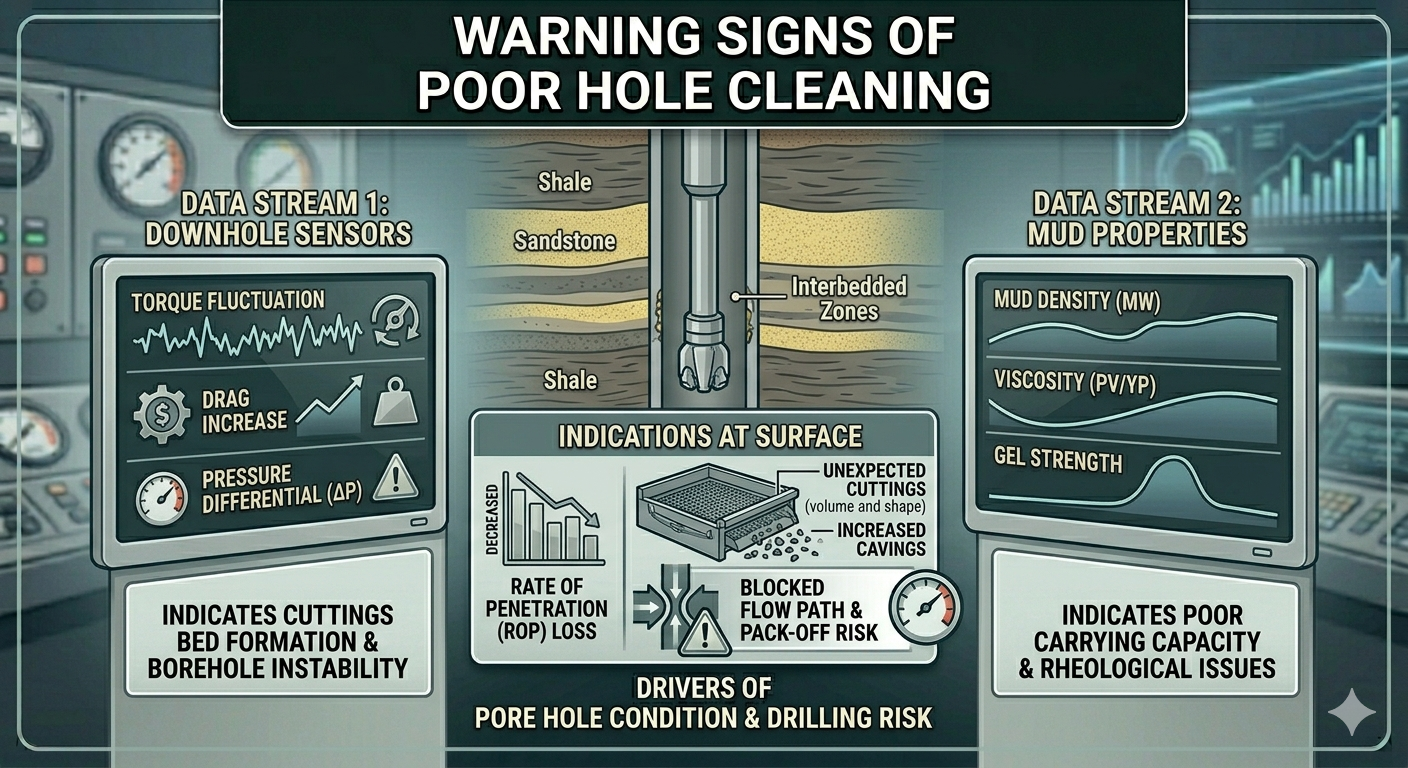
Hole cleaning becomes problematic when cuttings accumulate and form “beds” or build-ups along the low side of the wellbore, which can cause drag, torque spikes, pack-offs, and even stuck pipe. Typical indicators include: high torque or drag, poor cuttings returns at the shale shakers, excessive fill when tripping, or erratic pressure/spike behavior.
When early signs appear, remedial action should be taken promptly. Delaying actions increases the risk of a stuck pipe or lost circulation.
2. Remedial Practices: Quick Fixes for Cuttings Buildup
2.1. Cleanup Cycles: Full Circulation to Clear the Hole
What to do: Circulate the hole by pumping multiple bottom-up volumes at peak safe flow rate (within formation frac limits), combined with drill-string rotation (and, where appropriate, reciprocation) until the cuttings load returning to surface is cleared and no more solids appear on the shale shakers for a sustained period (e.g., 10–15 minutes).
Why it works: High flow and agitation resuspend and lift settled cuttings, restoring annular clearance and reducing ECD spikes associated with packed solids.
Field tips: Ramp up pump rate gradually to avoid pressure surges; monitor torque/drag carefully during circulation for annular restrictions. In vertical sections, thorough circulation alone often clears light build-up.
2.2. Sweeps: Targeted Pills for Enhanced Transport Efficiency
Sweeps (or “pills”) can help erase cuttings beds and re-establish hole-cleaning efficiency. However, their use must be carefully planned: well design, inclination, mud rheology, and flow capacity all influence effectiveness.
In vertical or near-vertical holes, high-viscosity (hi-vis) sweeps can be effective.
In deviated or high-angle holes, a single hi-vis sweep is often ineffective because viscous fluid tends to channel along the high side and may simply ride over the settled solids without disturbing them.
For such wells, a tandem-pill approach is more effective: first pump a low-viscosity unweighted pill (to generate turbulence and disturb the bed), followed immediately by a weighted or viscous pill (to enhance carrying capacity and lift the disturbed cuttings).
Sweeps design considerations:
Typical pill volumes based on hole size (per a standard reference) are: e.g., 30–50 bbl for 12¼" hole intervals; 20 bbl for 8½" intervals.
Sweep frequency depends on how fast cuttings load, but in deviated wells, a sweep every few stands (or before tripping/sliding) is often recommended.
During sweeps, maintain the maximum safe pump rate and rotate (or reciprocate) the drill string to maximize cuttings lift.
Field tip: Track shaker returns after sweeps; if cuttings persist, continue circulation until returns fall to baseline. Avoid repeated sweeps without evaluating effectiveness, as overuse can lead to barite sag or excessive ECD.
2.3. Wiper Trips: Mechanical Disturbance to Assist Cuttings Removal
When circulation and sweeps alone do not remove settled solids, especially in moderately inclined wells (e.g., 35°–60°), wiper trips (short trips up and down with circulation and/or rotation) can help mechanically disturb and scrape cuttings beds off the low side of the hole.
Best practices:
Trip up a few stands (e.g., 5–10), rotate or reciprocate during the trip to disturb the bed, then return to the bottom and re-drill.
Limit wiper trips to avoid excessive non-productive time — use 1–2 per day as needed.
Combine with a sweep or cleanup cycle for maximum effect.
When not to rely on wiper trips: In highly deviated or horizontal wells, simple trips may not access the low-side bed effectively; other methods (sweeps, circulation, or special tools) may be required.
2.4. Back-reaming: Last-Resort Option for Severe Restrictions
Back-reaming (reverse drilling while pulling out) may help clear severe plug-ups or highly compacted beds. However, it carries significant risk and is generally not recommended as a routine cleaning measure.
When to consider: Only after other cleaning methods (circulation, sweeps, wiper trips) have failed, and the drilling string is getting stuck or severely restricted.
How to execute safely:
Clean the hole first with at least one bottom-up circulation,
Back-ream slowly (e.g., 30–60 rpm) while pumping and rotating
Use the same flow rate used while drilling and limit the ECD
Limit back-reaming length, don’t try to backream huge lengths in a single continuous run
Monitor torque and drag. Stop if the torque exceeds a set threshold.
Circulate again after back-ream.
3. Proactive Hole-Cleaning Practices: Routine Preventive Steps
Rather than react only when problems appear, it’s far better to adopt proactive practices to prevent cutting build-up in the first place.
3.1. Drill Pipe Movement: Rotate and Reciprocate to Agitate
Maintaining drill-string rotation (or reciprocation) is one of the most effective ways to prevent cuttings from settling on the low side, particularly important when drilling deviated, extended-reach, or horizontal wells.
Recommended approach:
Continuous rotation at moderate to high RPM (depending on BHA and hole size).
In deviated sections, perform reciprocation (e.g., 10–20 ft every stand) or wiper trips to disturb the accumulation of cuttings.
Benefits: Keeps cuttings suspended or disturbed, reduces the risk of bed formation without requiring full trips or sweeps, and helps maintain drilling efficiency.
3.2. Controlled Tripping: Pre-Trip Cleanouts
Before tripping out of the hole (POOH), verify that the annulus is clear. Failure to do so can lead to excessive fill, stuck pipe, or pack-offs.
Recommended steps:
Circulate bottoms-up (e.g., 1.5 – 2 full hole volumes) at maximum safe flow and rotation until cuttings return to shakers fall to baseline levels.
If downhole inclination is high or there has been extended sliding, consider a sweep or wiper trip before or during POOH.
Additional tips: Pump sweeps every few stands if drilling long intervals without circulation; keep trip speeds controlled to avoid swabbing or surging pressure.
3.3. Directional / Slide-Drilling: Post-Slide Cleanups
Directional drilling or slide-drilling intervals often result in cuttings accumulation because the drill string may be static and the bit may generate cuttings without enough annular flow or rotation.
Best practice after slide intervals:
After finishing a slide section, perform a rotary wiper trip or sweep: rotate off-bottom for a few minutes, circulate at high flow, possibly reciprocate or trip 5–10 stands, then RIH and resume drilling.
Limit slide interval lengths (if possible), and avoid long static periods without circulation or rotation.
4. Contingency Planning and Routine Preparation
Good hole-cleaning practices also require planning, proper equipment, and readiness for abnormal events.
Pre-job planning: Use hydraulics and hole-cleaning modeling (including expected annular velocity, cuttings load, flow rate, and BHA geometry) to define baseline parameters and cleaning routines.
Maintain solids-control and mud-system efficiency: Ensure shakers, desanders/desilters, centrifuges, and other solids-control equipment operate at design efficiency.
Stock appropriate sweep materials, additives, and tools: Pre-mix sweep pills, keep under-gauge stabilizers, centralizers, and wiper-trip-friendly BHA on hand for use in difficult sections. Also consider using modern cleaning additives (e.g., fiber-based sweeps) that enhance suspension without drastically increasing viscosity.
Rig crew training: Ensure the driller, directional driller, mud engineer, and shale-shaker crew understand hole-cleaning indicators (e.g., returns, torque, ECD), when to initiate remediation, and how to execute sweeps or cleanouts.
References and Further Reading:
DrillingForGas. 2025. Hole Cleaning: Problems and Solutions. DrillingForGas.com. https://www.drillingforgas.com
Drilling Course. 2020. Drilling Fluid Issues for Extended Reach Drilling. DrillingCourse.com. https://www.drillingcourse.com
Studylib. 2025. Stuck Pipe Drilling Handbook: Hole Cleaning Pills and Practices. Studylib.net. https://www.studylib.net
EMEC. 2018. Drilling Fluids Manual: Pipe Rotation, Reciprocation, and Sweeps in Deviated Wells. islam-hamed.com. https://www.islam-hamed.com
SpringerLink. 2023. Improved Cuttings Transport in Horizontal Wells: Experimental Study on Rheology Impact. SpringerLink. https://link.springer.com
Fortacorp. 2024. Advanced Hole Cleaning: Fiber-Additive Sweeps (e.g., Super-Sweep). Fortacorp.com. https://www.fortacorp.com
Al-Azani, K., Al-Yasiri, M., and Mahmoud, M. 2023. A Novel Automated Model for Evaluation of the Efficiency of Hole Cleaning in Drilling Operations. Applied Sciences 13 (11): 6464. https://doi.org/10.3390/app13116464.
Power, D.J. and Hight, C. 2000. Drilling Practices and Sweep Selection for Efficient Hole Cleaning in Deviated Wellbores. SPE/IADC-62794-MS presented at the IADC/SPE Asia Pacific Drilling Technology Conference, Kuala Lumpur, Malaysia, 11–13 September. https://doi.org/10.2118/62794-MS.
Ofei, T.N., Amadi, J.O., and Appiah, J.O. 2023. Hole Cleaning during Drilling Oil and Gas Wells: A Review for Hole-Cleaning Chemistry and Engineering Parameters. International Journal of Chemical Engineering 2023: 6688500. https://doi.org/10.1155/2023/6688500.
Drilling Manual. 2019. Hole Cleaning in Drilling Deviated & Horizontal Wells. DrillingManual.com, 24 December. https://www.drillingmanual.com/drilling-stuck-pipe-hole-cleaning-p3/
Exlog. 2023. Hole Cleaning Monitoring (HCM). Exlog.com. https://www.exlog.com/services/surface-data-logging/wellbore-integrity-and-drilling-efficiency/hole-cleaning-monitoring-hcm
Yarim, G., Ritchie, G.M., and May, R.B. 2008. A Guide to Successful Backreaming: Real-Time Case Histories. Paper SPE-116555-MS presented at the SPE Annual Technical Conference and Exhibition, Denver, Colorado, USA, 21–24 September.
Disclaimer: This guide synthesizes and paraphrases industry best practices from referenced sources for educational and field-reference purposes only. It does not reproduce copyrighted material verbatim and is not official company policy or engineering advice. All information belongs to the original authors and publishers who retain full rights. No claim of original authorship is made for referenced concepts, and the document is distributed in good faith for drilling professionals.