Real-Time Monitoring for Effective Hole Cleaning: Tools and Best Practices
Share Your Thoughts and Additional Information
Hole cleaning is essential for safe, efficient drilling as it ensures that cuttings move from the bit to the surface without accumulating in the wellbore. Poor hole cleaning or insufficient monitoring can lead to stuck pipe, elevated torque/drag, pack-offs, or lost circulation, all of which cost time and money. This document outlines the key parameters to monitor, real-time tools to use, and best practices based on field-tested methods. Drilling teams can use these to spot problems early and react promptly, whether in vertical, deviated, or horizontal sections.
Key Monitoring Parameters for Hole Cleaning
To maintain effective hole cleaning, continuously monitor a few core parameters. Using rig sensors and software to log these values at each connection or stand helps ensure drilling conditions remain matched to the system’s transport capacity.
Flow Rate / Annular Velocity
Why it matters: The flow rate determines the annular velocity that lifts cuttings up the hole. If velocity is too low, particularly in high-angle wells, solids tend to settle.
Rule-of-thumb velocities: While specific flow targets depend on well geometry, mud density, and cuttings load, many field practices aim for elevated annular velocity when inclination increases.
Best practice: When running sweeps or circulating, ramp flow to the maximum safe rate (within ECD/formation limits). If pump capacity is limiting, consider combining circulation with string rotation or rheology adjustment to aid cuttings transport.
Drillpipe Rotation (and/or Reciprocation)
Why it matters: In deviated or horizontal wells, the drill pipe tends to lie on the low side of the hole, creating a narrow annular path on the bottom side where cuttings can settle and form a bed. Rotation (or reciprocation) agitates and lifts cuttings from the low side, preventing bed formation and promoting cuttings transport.
Recommended speeds and approach: Higher rotation speeds significantly improve hole cleaning. Some guidelines recommend 120 rpm or higher in larger-diameter wells; for smaller holes, lower RPMs may be used to avoid excessive string wear.
Best practice: Rotate the string whenever possible, particularly after sliding (directional drilling) or before trips. In sections prone to bed buildup, periodically reciprocate or perform wiper trips.
Mud Rheology — Suspending Cuttings and Preventing Settling
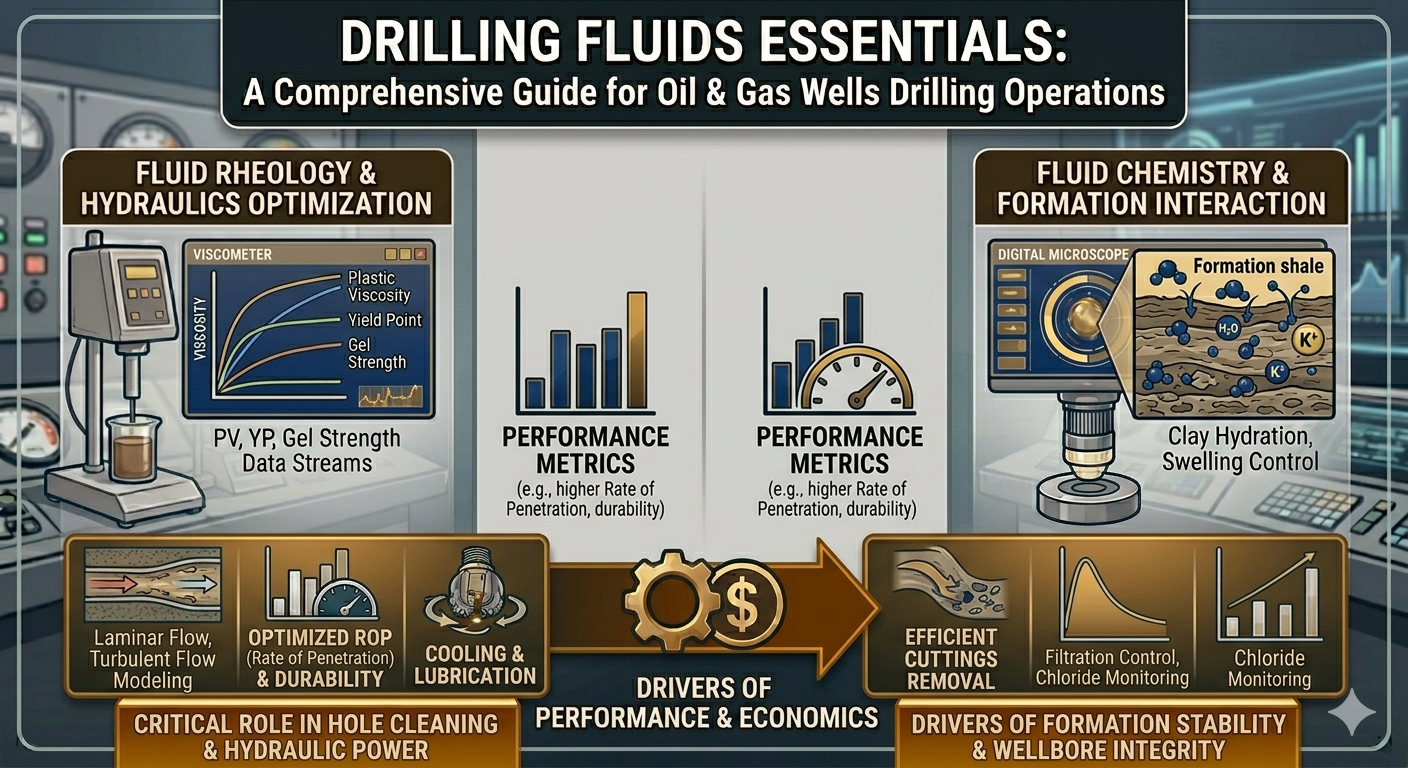
Proper mud rheology ensures cuttings stay suspended during circulation and static periods (e.g., connections, tripping). However, the rheology must be optimized for the wellbore geometry and flow conditions.
In vertical or near-vertical holes, increasing viscosity (and yield/gel strength) helps suspend cuttings during static periods.
In deviated or horizontal wells, where the pipe rests on the low side, excessively high viscosity alone may not improve hole cleaning, because viscous fluid tends to “channel” along the high side and fail to disturb the bed on the low side.
A balanced rheology approach is often better: relatively low plastic viscosity (PV) for pumpability, adequate yield point (YP) or low-shear viscosity to help carry cuttings, but avoiding over-thickening that reduces annular flow or increases ECD.
Best practice: Monitor mud properties every shift (viscometer, gels, etc.). Maintain rheology within target ranges; adjust as needed (e.g., by dilution or viscosity modifiers) if solids load or cuttings behavior worsens.
Rate of Penetration (ROP): Balancing Cuttings Generation and Removal
Faster ROP increases the volume of cuttings generated, thereby increasing transport demand on the mud/flow/annulus system. If the volume of cuttings exceeds the capacity to transport them, accumulation and cuttings beds result.
Best practice: Adjust ROP to match the cuttings transport capability. Use conservative ROP in deviated/high-angle/wide-hole sections; ramp up only when flow, rotation, and mud properties are sufficient. If cuttings returns drop (or other warning signs appear), slow down or pause drilling to perform clean-out sweeps.
2. Real-Time Monitoring Tools & Techniques
To effectively manage hole cleaning, integrate real-time monitoring tools, and compare observations with predictions or models. This enables timely corrective actions.
Pressure-While-Drilling (PWD) / Equivalent Circulating Density (ECD) Monitoring
What it does: Sensors in the annulus or downhole measure annular pressure while circulating; when converted to ECD, these readings help detect changes in flow path, annular restrictions, or cutting accumulation.
Interpretation: A steady ECD that matches modeled predictions suggests proper flow and cuttings transport. An unexpected ECD rise (especially > ~0.2 ppg over expected) may signal bed formation or the beginning of pack-off.
Best practice: Log PWD/ECD every connection or circulation interval. If ECD drifts upward, consider a bottom-up circulation with rotation, possibly using a sweep, before RIH or continuing drilling.
Torque & Drag Monitoring
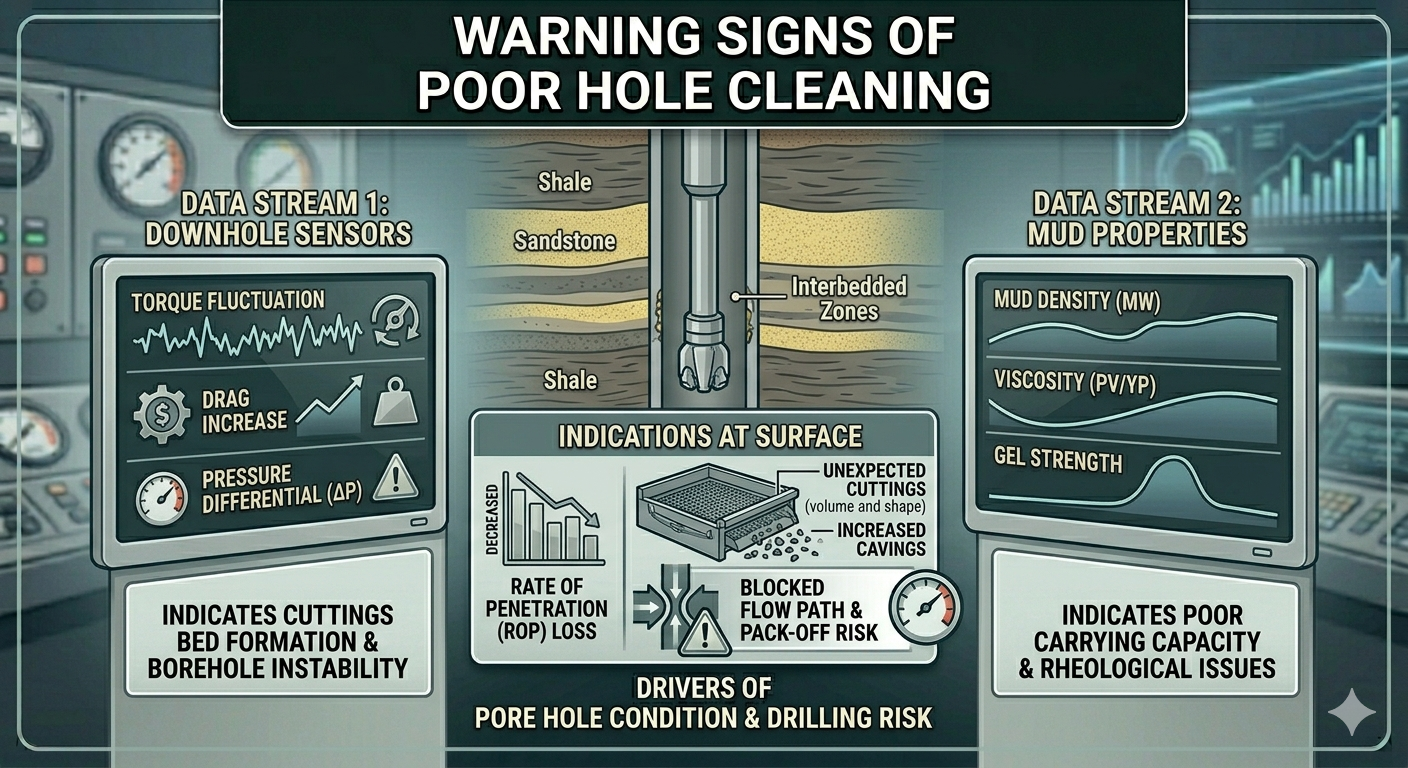
What it does: Surface (or downhole) sensors track torque and drag (pickup weight, slack-off weight, off-bottom torque, rotation torque). Rising torque or drag can indicate increasing friction from cuttings beds or plugging in the annulus.
Interpretation: If torque/drag trends deviate significantly from baseline (or model predictions), this may signal cuttings accumulation on the low side of the hole. High off-bottom torque compared to on-bottom torque is especially suspect.
Best practice: Record torque/drag per connection. If drag increases, consider sweeps, wiper trips, or circulation plus rotation/reciprocation to clear the hole before further drilling.
Shaker Returns and Cuttings Condition
What to monitor: Volume of cuttings returned compared to expected volume based on drilled footage; appearance of cuttings (size, shape, consistency). Sharp, well-formed cuttings are good. Small, rounded, “mushy,” or inconsistent cuttings often indicate recirculation or regrinding, indicating that cutting transport is inefficient.
Best practice: Weigh or volume cuttings regularly (e.g., every hour or per stand), and visually inspect. Train rig crews or mud loggers to classify cuttings “good vs poor.” If returns drop or cuttings look “worn,” stop drilling and circulate until cuttings clear.
Mud Properties & Solids Control Monitoring
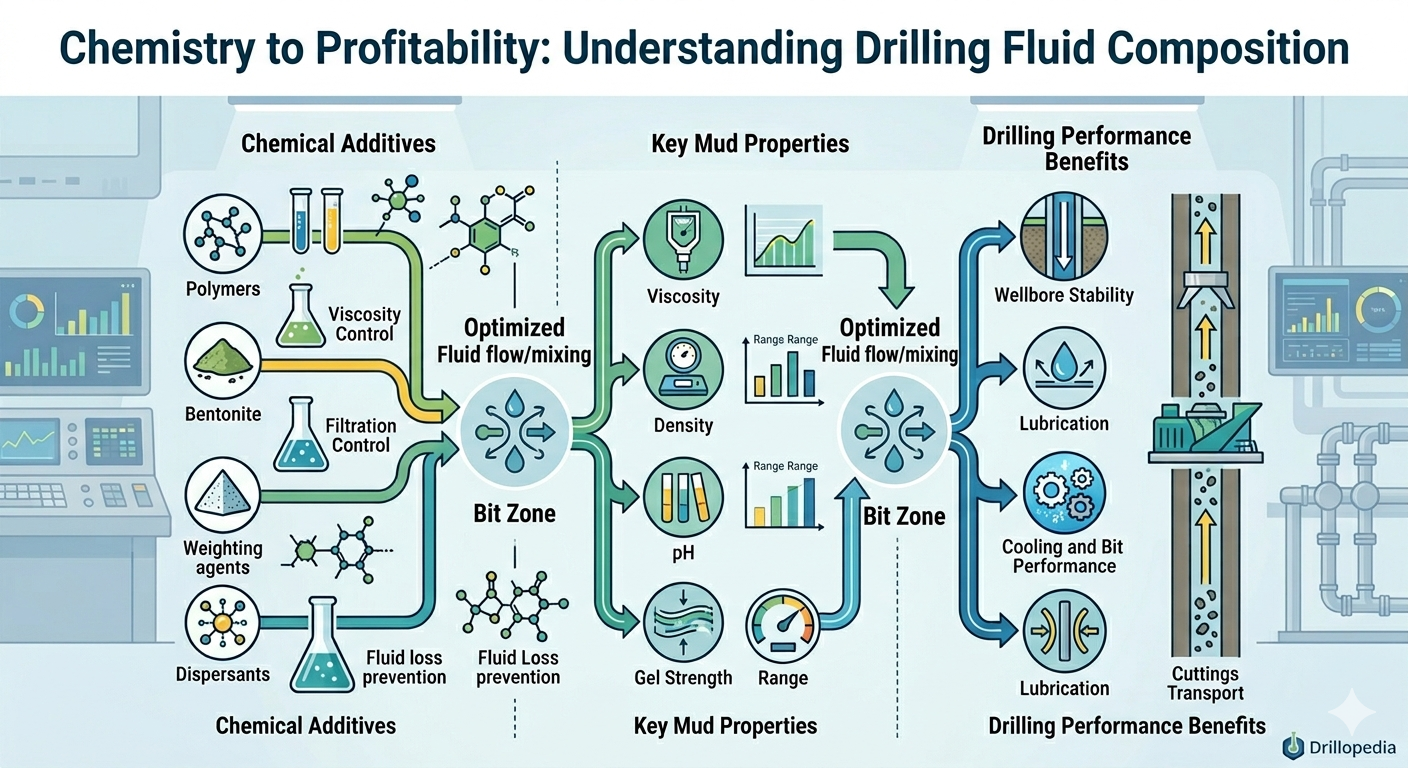
Why it matters: As drilling progresses, fine drilled solids, formation fines, or contamination can degrade mud carrying capacity, change rheology, and worsen cuttings transport.
What to track: Mud weight, plastic viscosity (PV), yield point (YP), gel strength (low-shear), and solids content (e.g., via MBT or lab tests).
Best practice: Test mud properties every shift (or more frequently if needed). If PV, YP, gel strength, or solids content rises, take corrective action such as diluting, adding viscosifiers or weight materials, or circulating sweeps. Also monitor for fine-sand buildup or agglomeration, which could worsen hole cleaning.
3. Sweep Strategy: When and How to Clean
Effective sweeps are a core component of a proactive hole-cleaning program, especially in deviated, extended-reach, or horizontal wells. But sweep design and timing must be carefully considered.
Tandem (Combination) Sweeps: Many field guidelines recommend a low-viscosity sweep first (to mobilize cuttings), followed by a weighted or high-viscosity sweep (to lift and transport the mobilized cuttings).
When to sweep: Periodically; every few stands, before tripping, after sliding, or when indicators (cuttings returns, torque, ECD) show potential build-up.
Sweep volume and composition: Dependent on hole diameter, length, and well geometry. For example, some guidelines for 12¼-in deviated holes specify a low-vis pill followed by a high-vis pill, with total pill volume sized to cover a portion of the annulus length (e.g., 100–150 ft or more).
Sweep execution: Pump at maximum safe flow rate; rotate (or reciprocate) the drill string during sweep circulation; monitor returns at surface carefully. Do not rely only on “set number of circulations”. Rather, circulate until the cutting's appearance returns to the expected baseline.
Watch for ECD or pressure spikes: Sweeps, particularly weighted or high-viscosity sweeps, can temporarily raise ECD or pressure losses; ensure this remains within safe limits before and while pumping.
4. Field Implementation — Routine Monitoring and Response Plan
To embed these practices into daily rig operations, consider adopting the following routine:
Pre-well preparation
Use hydraulics / well-bore cleaning modeling (with mud properties, hole geometry, planned ROP) to set baseline parameters (flow rate, rheology, rotation, sweep volumes/frequency).
Brief the drilling and mud teams on the plan and what to monitor during drilling.
Routine shift-by-shift monitoring
Log flow rate, pump pressure, string rpm, torque/drag, mud rheology, shaker returns (volume + appearance) every shift/connection/stand.
Enter data into a simple spreadsheet or rig-report form to enable trend tracking and early warnings.
Trigger-based sweeps and clean-outs
If shaker returns drop significantly, cuttings look degraded, torque increases, ECD rises, or cuttings volume on trips/connections increases — stop drilling and perform a tandem sweep (low-vis followed by weighted/high-vis), with rotation/reciprocation.
Circulate bottom-up until cuttings return to the expected volume and quality.
Mud and solids control management
Perform regular mud checks (viscosity, gel strength, solids content).
If mud shows signs of overloading (high solids, high PV/YP), treat by diluting, adding additives, performing clean-outs, or replacing mud, if necessary.
Post-well review and continuous improvement
After each well (or section), review the monitoring data logs, sweep events, and any hole-cleaning issues.
Adjust the hole-cleaning program for future wells based on lessons learned.
5. Why Rig-Wide Discipline on Hole Cleaning Matters
Effective hole cleaning is not optional, especially in deviated and extended-reach wells. Real-time monitoring combined with proactive sweeps and good mud/rheology management helps prevent cuttings bed formation, reduce torque/drag, avoid stuck pipe or pack-offs, and keep drilling efficient and safe.
By embedding these practices into rig operations, drilling teams can transform hole cleaning from a reactive “fix-when-it-breaks” task into a proactive, planned activity, reducing non-productive time and improving overall drilling performance.
References and Further Reading:
OilfieldTeam. 2025. Drilling elements that affect hole cleaning. OilfieldTeam Website. https://oilfieldteam.com/en/a/learning/Drilling-Elements-That-Affect-Hole-Cleaning
Scribd. 2024. Hole cleaning in directional wells. Scribd Document. https://www.scribd.com/document/761215989/Hole-Cleaning-in-Directional-Wells
DrillingCourse. 2020. Template technical test – drilling engineering and operations. DrillingCourse Website. https://www.drillingcourse.com/2020/07/template-technical-test.html
Aldea, C. 2005. Hole cleaning in directional wells. AADE-05-NTCE-29. AADE National Technical Conference and Exhibition, Houston, Texas, 5–7 April. https://www.aade.org/application/files/4715/7304/0407/AADE-05-NTCE-29__Aldea.pdf.
DrillingForGas. 2023. Hole cleaning. Drilling For Gas Website. https://www.drillingforgas.com.
Scribd; DrillingCourse. 2024. Technical guidelines on hole cleaning practices in deviated wells. Online compilation (Scribd + DrillingCourse).
Drilling Manual. 2019. Hole cleaning in drilling deviated and horizontal wells. Drilling Manual Website. https://www.drillingmanual.com/drilling-stuck-pipe-hole-cleaning-p3/.
Doshi, S.V. 2022. Guidelines to effective hole cleaning. Presentation posted on Scribd. https://www.scribd.com.
SpringerLink. 2024. Recent research on cuttings transport, drillstring rotation, and sweep effectiveness. SpringerLink. https://link.springer.com.
Power, D.J. and Hight, C. 2000. Drilling practices and sweep selection for efficient hole cleaning in deviated wellbores. SPE/IADC-62794-MS presented at the IADC/SPE Asia Pacific Drilling Technology Conference, Kuala Lumpur, Malaysia, 11–13 September. https://doi.org/10.2118/62794-MS.
Roy, S. and Power, D. 2002. Using real-time hydraulics modeling to complement annular pressure-while-drilling data. Paper AADE-02-DFWM-HO-37 presented at the AADE Technology Conference, Houston, Texas, USA, 2–3 April.
Al-Azani, K., Al-Yasiri, M., and Mahmoud, M. 2023. A novel automated model for evaluation of the efficiency of hole cleaning in drilling operations. Applied Sciences 13 (11): 6464. https://doi.org/10.3390/app13116464.
Drilling Manual. 2021. Drilling parameters definitions and optimization. Drilling Manual Website, 12 October. https://www.drillingmanual.com/drilling-parameters-optimization-performance-oil-gas/.
Exlog. 2023. Hole cleaning monitoring (HCM). Exlog Website. https://www.exlog.com/services/surface-data-logging/wellbore-integrity-and-drilling-efficiency/hole-cleaning-monitoring-hcm.
Disclaimer: This guide synthesizes and paraphrases industry best practices from referenced sources for educational and field-reference purposes only. It does not reproduce copyrighted material verbatim and is not official company policy or engineering advice. All information belongs to the original authors and publishers who retain full rights. No claim of original authorship is made for referenced concepts, and the document is distributed in good faith for drilling professionals.